It has been 20 years since Ann Kazimirski passed away, yet her passion for championing the cause of Holocaust education lives on. When her daughter Heidi Berger makes presentations under the auspices of the Foundation for Genocide Education, Ann is literally right by her side.
On April 17 Berger spoke to students at Westmount High School during a week that marked Yom Hashoah, Holocaust Remembrance Day. Via posthumous video testimonials about the harrowing experiences she endured, Ann Kazimirski shares how she lived through the tragedy and heartbreak of the Holocaust at the young age of 17. Sixty-four members of her family perished during World War II, leaving her the only survivor. “Her mission in her life became going to schools all over North America and telling her story and talking about genocide,” Berger said. “She realized children of survivors have to carry on the story.”
After Ann died in 2006 of natural causes, Berger vowed to continue her work. She realized teachers needed help. So, she started the Foundation for Genocide Education. Its mission is to ensure that the history of genocide and the steps leading to it are taught in high schools across Canada and the United States. They accomplish this by collaborating with governments and pedagogical experts on groundbreaking resources about genocide, such as the new guide, “Studying Genocide.”
Since 2010, Berger has shown her interactive presentation to high schools, universities, adult organizations and symposiums throughout Canada and the United States. The team of presenters has been expanded to include more children and grandchildren of survivors from the Holocaust, along with survivors of the genocide against the Tutsi in Rwanda, descendants of the Armenian genocide, and descendants of the genocide of Canada’s First Nations.
Ann grew up in the small town of Vladimir Volynsky. She was 17 when the Germans invaded Poland. Some Jews were taken in trucks to concentration camps, while others were forced into ghettos surrounded by barbed wire. Benny, her 18-year-old brother, and Joshua her father were part of the first group of Jews to be killed. They were brought to the town prison to be executed. Three aktion, or killing operations, were to happen. During the first aktion, Ann, her husband Henry and her mother hid in the attic of a military dental clinic right across from the ghettos. Hahn, a German dental technician who was a friend of Henry, risked his life to save them by allowing them to hide there.
One morning they heard screaming, and from a small window in the attic they saw the horror. They saw men being beaten and shoved into trucks which were everywhere. They heard the men screaming, “Lama hazavtonu?” (“Why have you forsaken us?”) Women tried hiding their children under their dresses, but were unsuccessful. During the second aktion, a Polish woman hid Ann, Henry and her mother in her attic until her husband discovered them and threatened to report them. They were then forced to finally go to the ghetto.
The goal of the third aktion was to make the town of Vladimir Volynsky “Judenrein” (cleansed of Jews). Germans shot many of the Jews and many more died trying to escape by climbing the barbed wire fences. Ann and Henry found yet another place to hide, but were separated from Ann’s mother. One day Ann recognized her mother in a group of five who were lined up near a wall and shot. Ann recalls the memory in her book “Witness To Horror”: “I will never forget the image of the red blood staining the white snow. I saw my beloved mother die and there was nothing I could do.”
Nineteen-thousand Jews, including 1,000 children, died in Vladimir Volynsky. Even though Henry and Ann survived the massive killing, it wasn’t over yet. They began their voyage to the Russian front. Mark, their first son, was born in Lwow. At that point their objective was to get to Berlin. When they finally reached their destination, they discovered that the city was on fire and there were epidemics of many illnesses. Mark became sick and they almost lost him.
The family then moved to Munich and settled in Garmish where their second son, Seymour, was born. The hatred of Jews was still part of their lives. A young girl they hired to help in the house tried to poison Mark. They later found out that she was a member of the Hitler Youth movement. The Hitler Youth were the young children who were educated and trained in Nazi principles.
In the spring of 1948, they received their visa to go to Canada. A joyous time that was to finally leave war-torn Europe. They settled in Ste. Agathe, north of Montreal, where Heidi was born. Most survivors, including Ann and Henry, did not discuss the Holocaust until they felt their children were old enough to understand. Even then they did not discuss the details; the memories were too painful to bring back.
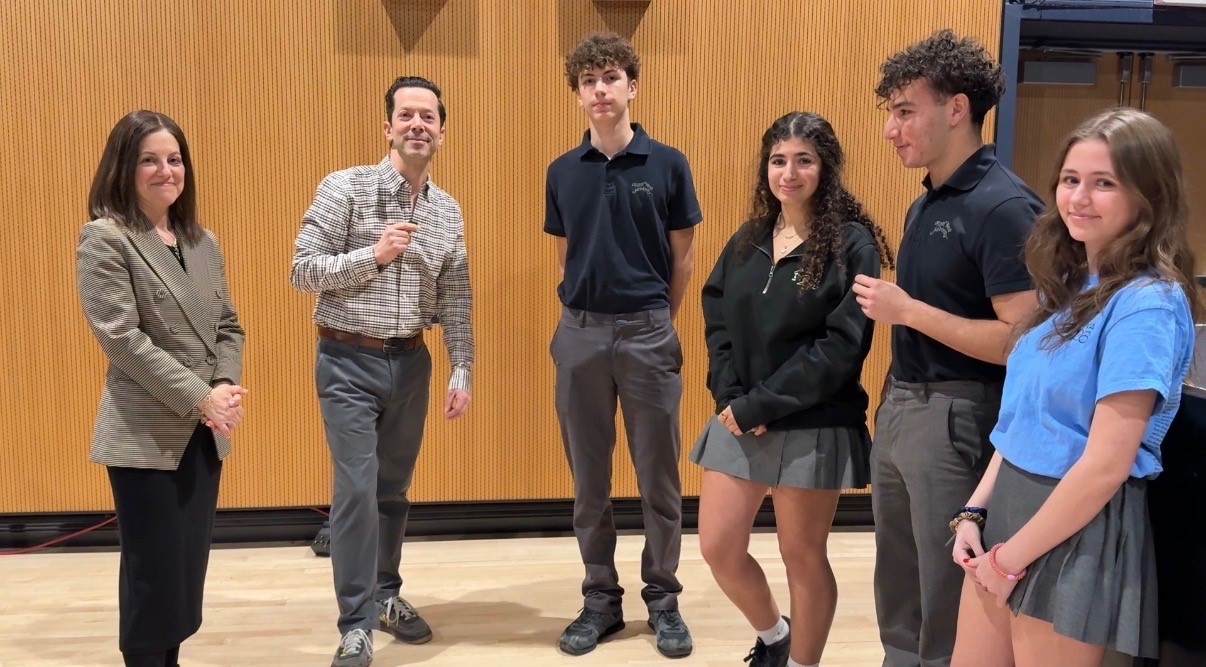
For the staff and students of Westmount High School, as well as special invited guests and EMSB officials, Berger’s presentation truly left a strong impression and it was indeed as if Ann was there in person as well. “I am very grateful for the work of the English Montreal School Board for making this happen,” she said. “It was very meaningful to be here. My mother spoke here many, many years ago. It is important we continue going into schools, fighting hate, bullying and intolerance.”
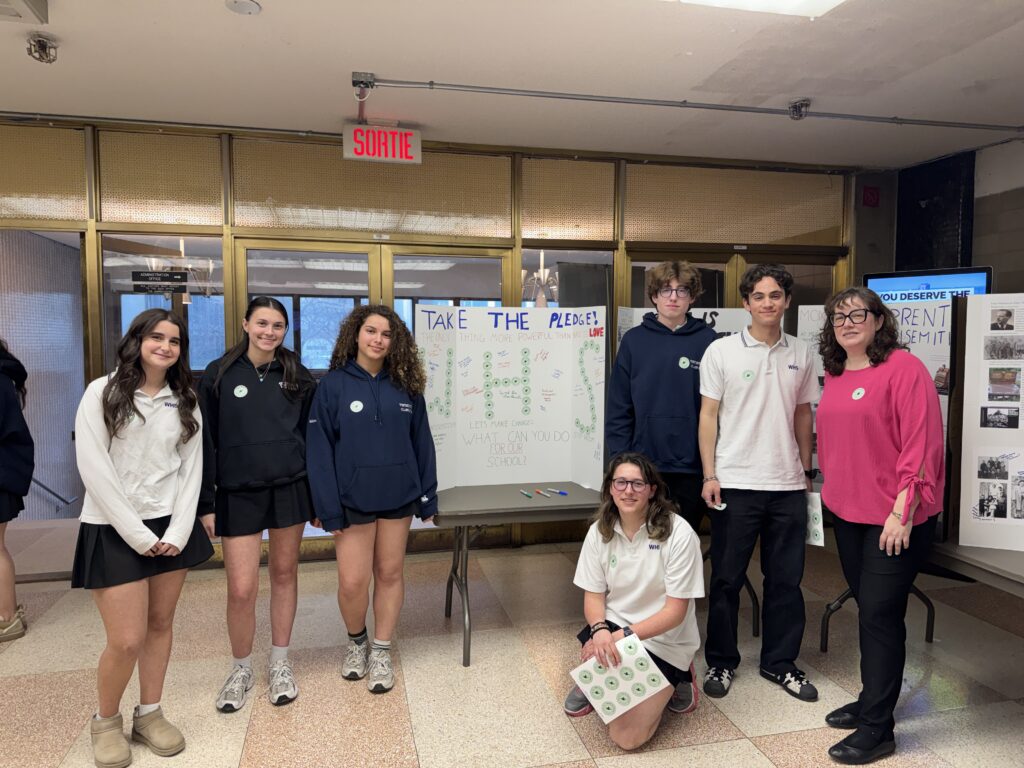
During the week preceding the talk, teacher Chantal Clabrough and some of her students set up an information kiosk in the school lobby to talk about Holocaust education and the evils of antisemitism.